Why Your AI SaaS Product Fails in Month 14 (And How to Architect Around It)
EPixelSoft Team
|
2 Jul 2026
|
7 Min Read
Share
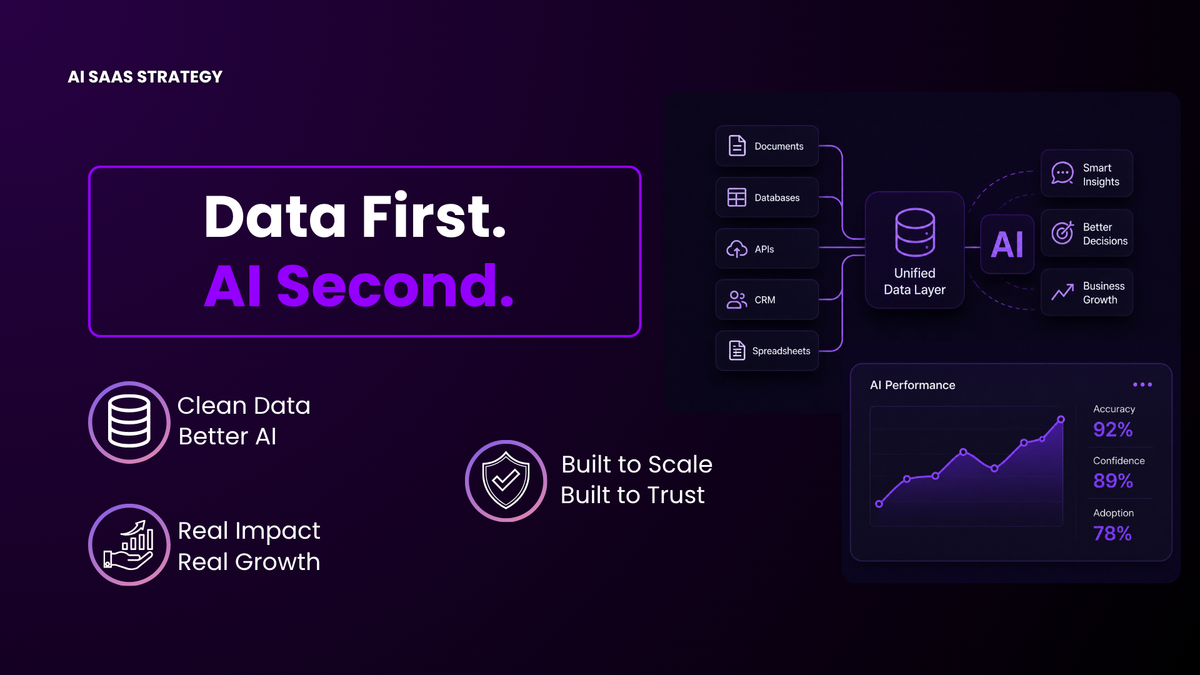
AI-native SaaS development requires funded founders to make a critical architectural decision in week one: treat AI as the product's core data layer, or treat it as a feature added on top of existing application logic. According to RAND Corporation research, more than 80% of AI projects fail to reach meaningful production deployment. MIT Project NANDA (July 2025) found that 95% of organizations deploying generative AI saw zero measurable financial return. In every post-mortem, the failure traces to the same root cause: the data foundation was not ready when the AI model needed it. Founders who design the data pipeline first ship AI products that hold. Those who design the AI first spend month 14 rebuilding from scratch.
The pattern repeats often enough that it has a shape. A founder has a genuine insight about a workflow that AI could improve — underwriting, contract review, field data collection, and customer support triage. They hire a team, choose a model, and build toward a demo. The demo is compelling because the data feeding it is curated. The schemas are clean. The volume is controlled. Everyone in the room is convinced.
Then the product goes to real users.
Real users have inconsistent data. They import from five different CRMs. They upload PDFs that have been scanned twice. They have field names that mean different things in different departments. The AI model — which performed beautifully on curated test data — now produces unreliable outputs. The team scrambles. Data cleaning becomes a full-time engineering job. The roadmap stalls. By month 14, the original product is being partially rebuilt, and the investors want to know why.
Why Bolt-On AI Is an Expensive Detour
S&P Global's 2025 survey found that 42% of companies abandoned most of their AI initiatives that year — up from just 17% in 2024. The acceleration of failure is not because AI got harder. It is because more teams tried to add AI to architectures that were never designed to support it.
The most common version of this looks like a mature SaaS product with a new AI layer installed on top: a chatbot added to the dashboard, a summarisation feature bolted to the document viewer, a recommendation engine plugged into the reporting module. Each feature works in isolation. None of them share a coherent data model. None of them feed back into each other. The user experience feels fragmented because the architecture is fragmented.
The EPixelSoft engineering team has spent 12 years building production software for organizations where the stakes are high — FinTech lenders, HealthTech platforms, international NGOs, and funded SaaS startups across the US, UK, Africa, and Asia. With 700+ systems shipped and a proprietary AI platform running in the field, the team writes from direct delivery experience: what breaks in production, what actually works, and what the vendor pitch never tells you.
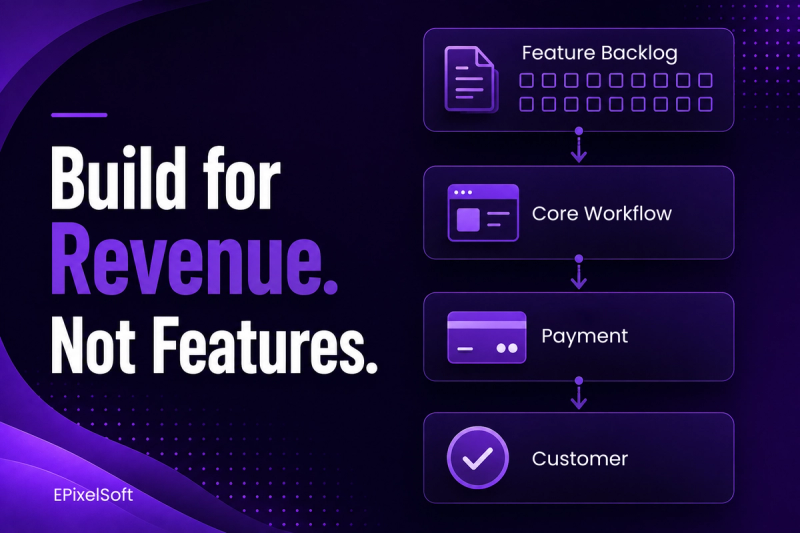
An analysis of AI SaaS failures in 2025 identified what it called the "Smart Feature fallacy": building multiple AI capabilities without anchoring the product to a core problem worth solving. The result is technically impressive but practically incoherent. Users cannot explain what the AI actually does for them. Retention suffers. Churn arrives quietly in month eight and becomes a crisis by month sixteen.
The honest version of this failure is a data quality problem wearing an AI costume. The model is fine. The data pipeline feeding it is not.
What AI-Native Architecture Actually Means
AI-native does not mean AI everywhere. It means the product is designed from week one with three things in place before the AI model is selected: a data ingestion strategy, a data quality layer with automated governance, and a feedback loop that improves the model as users generate new data.
The data ingestion strategy answers a simple question: where does the data come from, in what format, and how often? Most teams skip this in week one because they are focused on the product vision. By month six, the answer to that question determines whether the product works. If the ingestion layer is not designed to handle real-world messiness — multiple input formats, missing fields, schema variations between clients — the AI model will inherit every one of those inconsistencies and amplify them.
The data quality layer is where most early-stage teams push back hardest. It feels like infrastructure work that delays the product. It is actually the product. Gartner defines AI-ready data as data that is governed at the asset level, supported by automated quality gates, and continuously monitored — not audited quarterly. That cadence matters. AI models running in production need data quality signals measured in hours, not months. Teams that skip the quality layer find this out expensively.
The feedback loop closes the architecture. Every user action — accepted suggestions, corrected outputs, ignored recommendations — is a training signal. Products that capture this data from day one improve automatically. Products that do not capture it require expensive manual retraining cycles or, eventually, a complete architecture rethink.
What This Looks Like in a Real Production System
A US commercial lending company came to us with an underwriting workflow that took nine days on average. The team had already experimented with an AI model to accelerate document review. The model worked in testing. In production, it was unreliable — different document formats from different brokers, inconsistent field naming across loan types, and no mechanism to track when the model's confidence was low enough to escalate.
The first three months of the engagement were not spent improving the AI model. They were spent building the data layer it needed to perform. That meant a normalisation pipeline that could ingest documents in multiple formats and extract structured fields consistently, a confidence scoring system that flagged outputs below a defined threshold for human review, and an audit trail that made every AI decision traceable — which the compliance team required before the system could be used in production at all.
Once that foundation was in place, the model performed. The underwriting cycle dropped from nine days to 38 hours. Team throughput increased fourfold. The AI was the same category of technology the team had tried before. The difference was what was underneath it.
This is not an unusual result. McKinsey research shows that companies with strong data and personalisation infrastructure generate 40% more revenue from AI-driven product features than those without. The model matters less than the data it runs on.
What It Actually Takes to Build This Before You Run Out of Runway
Funded founders face a real tension here. The investors want to see the product. The product needs an infrastructure that does not look like the product. This is where most engineering decisions get made under the wrong kind of pressure.
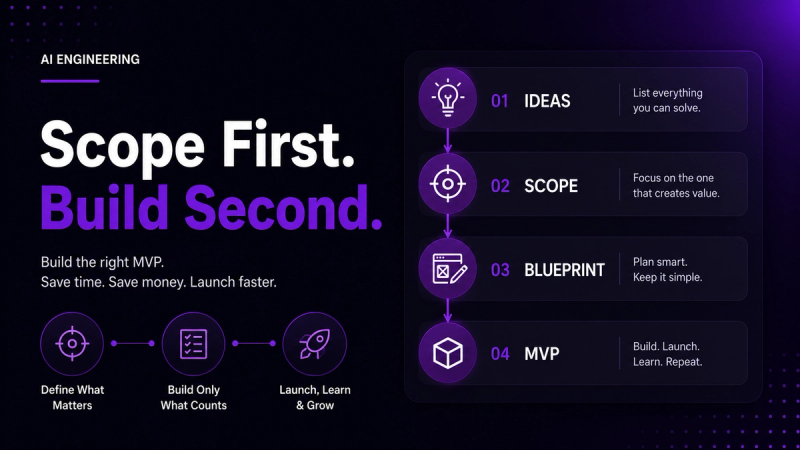
The practical resolution is sequence, not compromise. Build the data ingestion and quality layer in the first sprint. Do not build it to be perfect. Build it to be honest — it should capture what you actually have and make the messiness visible rather than hiding it. A system that tells you your data has gaps is more useful than one that silently fails on them.
Select the AI model after the data architecture is stable, not before. The choice of model matters far less than most founders think at this stage. OpenAI, Anthropic, Google, and open-source alternatives are all capable of powering production features when the data they receive is consistent, governed, and relevant. Model selection becomes a cost and performance optimisation conversation, not a foundational decision.
Track cost per inference from day one. AI-native startups growing at near 100% annually — a benchmark cited by multiple 2025 SaaS reports — share a discipline around unit economics that most early-stage founders ignore until the cloud bill arrives. Flat-rate unlimited pricing on a usage-based cost structure has ended more AI SaaS products than poor model quality. Budget the inference costs into the pricing model before launch.
Build the human-in-the-loop mechanism before it is needed. Every AI system will produce outputs that a user disagrees with or that a regulator challenges. The teams that design the escalation path before deployment treat it as a workflow feature. The teams that design it after a compliance incident treat it as a crisis response.
The Decision That Happens in Week One
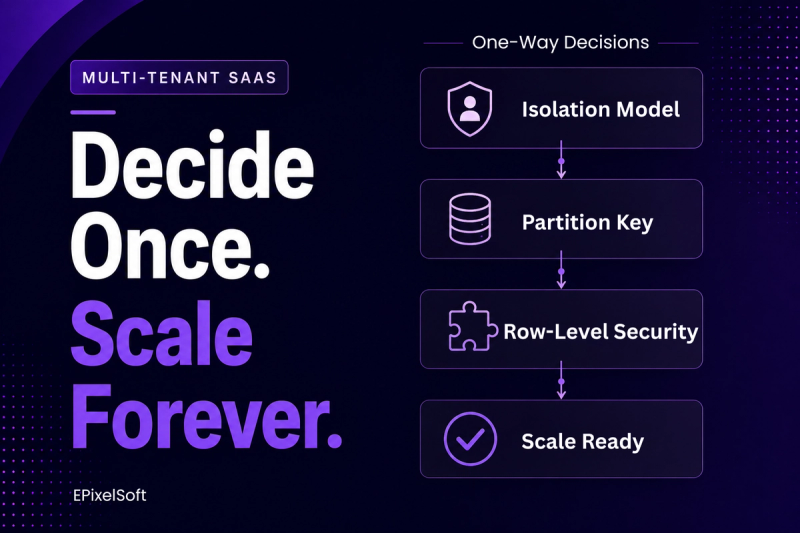
By mid-2026, the market will have drawn a clear line between AI-native SaaS products and AI-assisted ones. The distinction is not marketing language. It is an architectural choice made in the first two weeks of a product build that becomes impossible to undo without significant cost eighteen months later.
The founders who get this right share one habit: they define the data contract — what data the AI needs, in what format, at what quality threshold, and from what sources — before they define the product features. The features are downstream of the data. Always.
If your AI SaaS product is currently in planning or early development, the most important conversation you can have is not about model selection. It is about what your data pipeline looks like on the day your hundredth customer imports their data in a format you did not expect.
If you are in month twelve and the product is not performing the way the demo did, the answer is almost certainly in the data layer. Build that first. The model will follow. If you are building an AI-native SaaS product and want a second opinion on your architecture before the cost of getting it wrong compounds, talk to the EPixelSoft team at epixelsoft.com/contact.
EPixelSoft is an AI-native software engineering company based in Noida, India. Since 2014, we have shipped 700+ production systems across FinTech, HealthTech, NGO operations, and SaaS.


)