How to Scope a SaaS MVP Without Wasting the First $50,000
EPixelSoft Team
|
3 Jul 2026
|
7 Min Read
Share
The founder handed us a Notion document. Forty-seven pages. Feature list, user stories, competitor screenshots, a Figma mock of the dashboard they wanted, and a section at the end called 'Phase 1' that was longer than most finished product specs. They wanted a quote for the MVP. The honest answer: what they had described was not an MVP. It was a full product, organised into a Notion doc and relabelled.
This is the most common way SaaS budgets break. Not in development. Not because of bad engineering or wrong technology choices. Before a single line of code is written, in the document (or conversation, or Loom video) that a founder uses to brief an engineering team.
The Standish Group's CHAOS Report, which has tracked software project outcomes for three decades, found that only 31% of IT projects are completed on time and within budget. Scope problems sit at the root of most of the other 69%. EPixelSoft has taken intake calls with founders across the US, UK, and Africa for over twelve years. The pattern is consistent. Founders do not overspend because they choose expensive engineers. They overspend because they have not decided what they are building before they start paying for it.
Why the Feature List Is Not a Scope
A feature list is a wish list written by someone who hasn't yet had to pay for each wish individually. The problem is not the features themselves. Most of what founders ask for is reasonable for the eventual product. The problem is that a feature list tells an engineering team what to build, but it says nothing about the logic behind each feature, the data architecture it requires, the third-party integrations it assumes, or the edge cases it will generate.
Two founders can hand over identical feature lists for a SaaS product and end up with builds that differ by $40,000 and twelve weeks. One has a clean data model, bought authentication infrastructure rather than building it, and treated billing as a Tier 1 deliverable from day one. The other has custom auth, billing deferred to 'later,' and a database schema that will need to be rebuilt the moment a second customer type appears. The feature list looked the same. The scope was entirely different.
According to a 2026 analysis of SaaS MVP cost drivers, scope creep accounts for 40 to 60 percent of overruns in projects that started with a clear scope (TechConcepts, 2026). The mechanism is always incremental. A stakeholder talks to a prospect who mentions a feature. The stakeholder adds it to the spec without removing something else. The developer estimates it as a small addition. Repeat five times, and a ten-week build becomes sixteen weeks. Nobody in that sequence made a bad decision. The process lacked a mechanism for saying no.
The EPixelSoft engineering team has spent 12 years building production software for organizations where the stakes are high — FinTech lenders, HealthTech platforms, international NGOs, and funded SaaS startups across the US, UK, Africa, and Asia. With 700+ systems shipped and a proprietary AI platform running in the field, the team writes from direct delivery experience: what breaks in production, what actually works, and what the vendor pitch never tells you.
Scoping is not a task that happens in a product discovery meeting. It is the output of answering four specific questions with enough precision that an engineer can make architectural decisions from the answers.
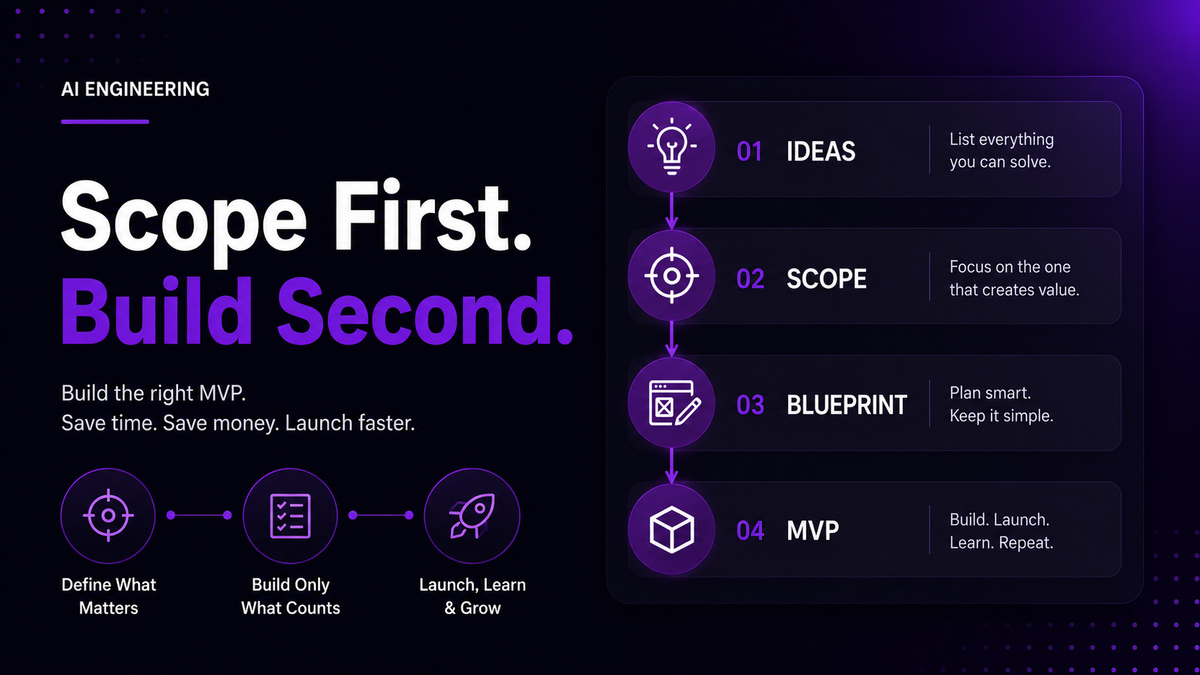
First: what is the single workflow the MVP must complete end-to-end? Not a list of features. One workflow. A user arrives, does something specific, and leaves having received value. If you cannot describe this in two sentences, the scope is not ready. Everything else in the MVP exists to support this workflow or to get a user into it.
Second: what does each user type actually need on day one? Multi-role SaaS products (admin, manager, field user, viewer) are some of the most expensive MVPs to build because role-based permissions multiply the surface area of every feature. If the MVP can launch with one primary user type and a simplified admin panel, that single architectural decision can reduce build time by weeks.
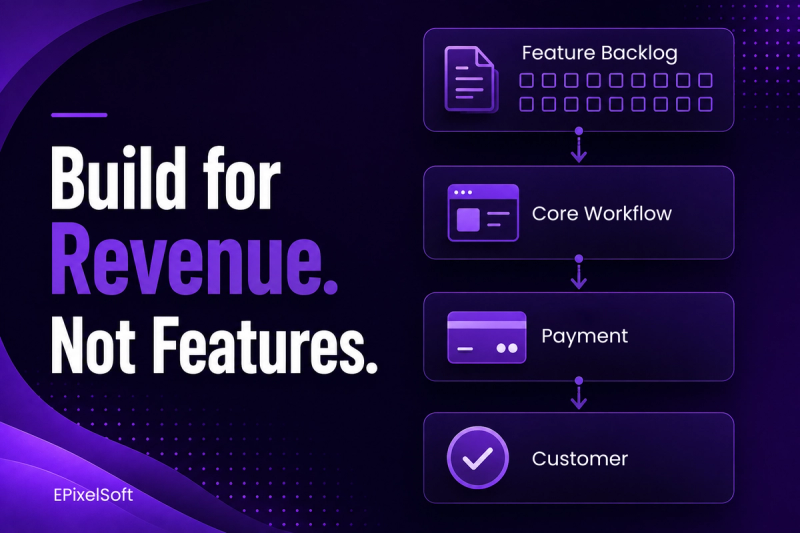
Third: which infrastructure is being bought, and which is being built? Authentication, billing, and transactional email are solved problems. Auth0 or Clerk handles auth. Stripe handles subscription billing, proration, and dunning. Resend or Postmark handles transactional email. Founders who insist on building any of these from scratch are paying engineers to solve problems that were solved years ago. Buying this infrastructure typically saves four to six weeks on a mid-complexity MVP.
Fourth: what would have to be true for this build to have been worth it? Define a success metric before code is written. Not 'good user feedback.' Specific: ten paying customers in ninety days, or a conversion rate above a threshold, or a signed letter of intent from one enterprise buyer. Without this, there is no mechanism for deciding when the MVP is done and iteration should begin. The build continues adding features until the money runs out.
What Scope Creep Actually Costs in Production
The sprint-level version of scope creep is familiar. Features added mid-build, timeline slips, budget requests that feel unexpected but in retrospect were entirely predictable. The more expensive version happens earlier, at the architectural layer.
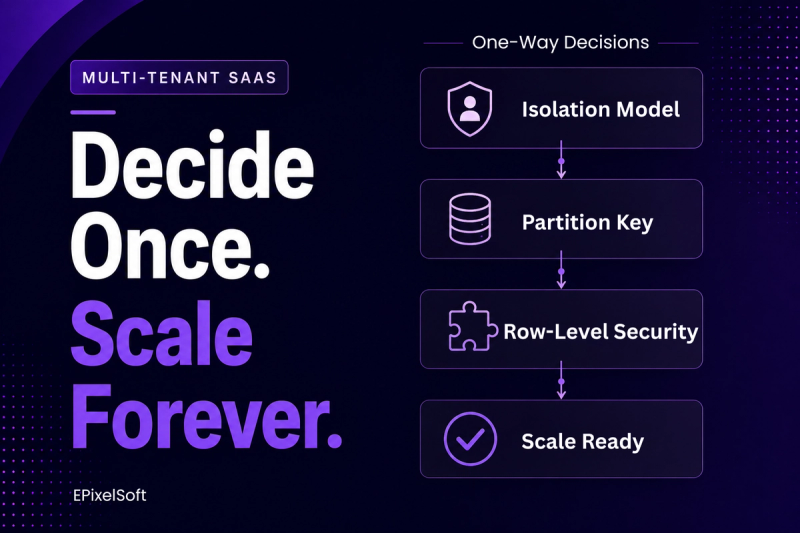
The single-tenant versus multi-tenant decision is a common example. A founder describes a SaaS product for teams and assumes the engineering team will build it to serve multiple organisations from day one. The engineering team builds it for a single organisation because that was simpler and the spec was ambiguous. When the second customer arrives with different data requirements, the schema needs to be rebuilt. That rebuild costs more than the decision would have cost to make correctly at the start.
Compliance is another version of the same problem. A SaaS product that handles personal data, financial transactions, or health records has compliance requirements that are cheaper to design in than to retrofit. According to analysis of SaaS MVP build patterns, retrofitting compliance after the fact typically costs four times what designing it in upfront would have cost (TechConcepts, 2026). Founders who defer this conversation because it feels like an engineering problem discover during their first enterprise sales conversation that it was actually a sales problem all along.
The most invisible form of scope creep is what gets built in the authentication layer. Basic email-and-password login is a solved problem. But each addition compounds the cost. Social login adds one to two days per provider. SSO for enterprise adds two to three weeks. Multi-factor authentication adds a week. These are all reasonable features for the eventual product. Combined in a first build before there are paying customers to justify them, they can add $15,000 and five weeks to a single-user MVP.
Discovery Is Not Optional and Should Not Be Free
The industry norm of offering free discovery calls as a sales tool has created a damaging expectation: that scope definition is something an engineering partner does before the commercial engagement begins, at no cost to the founder. The reality is that proper discovery (two to four weeks of requirements engineering, architecture planning, and user story mapping) is the most high-leverage work in the entire engagement.
Skipping a structured discovery phase typically causes three to five times more rework after development begins (Developex, 2026). The discovery phase costs approximately five to ten percent of the total build budget. Spending $3,000 to $5,000 on a structured scope workshop typically saves $8,000 to $15,000 in downstream rework, according to analysis across 50-plus SaaS builds.
What a proper discovery phase produces is not a longer feature list. It produces a prioritised backlog with explicit must-have and must-not-have designations, a data model reviewed for multi-tenancy decisions, a clear mapping of which infrastructure will be purchased versus built, and an agreed definition of done for every feature before development begins. Ambiguous acceptance criteria are the mechanism by which scope creep enters a fixed-budget engagement.
AI-assisted development tools have changed some of the economics here. According to a GitHub study on Copilot productivity, developers using AI coding tools complete routine tasks up to 55 percent faster on average. In practice, this compresses the lower-end cost range of MVPs by 15 to 25 percent for well-defined, repetitive work: CRUD operations, API scaffolding, UI component generation. For complex MVPs with compliance requirements or deep third-party integrations, the savings are marginal, in the range of five to ten percent, because AI tools do not reliably handle system design or integration orchestration. The implication for founders: AI tooling lowers the cost of building, but it does not reduce the cost of building the wrong thing.
What Tight Scope Looks Like in Practice
In 2024, EPixelSoft worked with a B2B SaaS client in the e-commerce space. The founder came with a product vision for a multi-tenant platform managing seller operations across multiple marketplaces. The feature list had thirty-two items.
The discovery process reduced the MVP to one core workflow: a seller connects their marketplace account, the platform pulls their performance data, and they receive a structured report. Eight features. The authentication infrastructure was bought (not built). Billing was integrated from day one. The data model was designed for multi-tenancy from the start, even though the first version only served a single account type.
The platform launched on schedule. Within ninety days it had 500 paying customers. The twenty-four features that were deferred are now in the product. They were built in order of what the paying customer base actually asked for, not in the order a feature list imagined they would.
A subscription SaaS client in the creative industry came through a similar process. The MVP launched with a narrow feature set and a clear onboarding flow. After launch, the team iterated based on actual subscriber behaviour. Subscriber numbers grew fivefold within the first several months of operation. The growth was not driven by the features that were deferred. It was driven by the product doing one thing well for a specific user.
Before You Brief an Engineering Team, Answer These
A practical pre-brief checklist. If the answer to any of these is uncertain, the scope is not ready:
Can you describe the primary user workflow in two sentences? Have you identified which infrastructure will be bought (auth, billing, email) versus built? Have you defined the data tenancy model — single-tenant or multi-tenant — before development begins? Have you listed every feature and marked each explicitly as required for launch or deferred? Have you defined a measurable success metric that will tell you when to stop building and start iterating? Have you allocated budget for discovery, not just development?
If the answer to any of these is 'we'll figure it out in development,' the budget is already at risk. Not because engineers will make bad decisions but because the absence of a decision is itself a decision, usually the most expensive one available.
The First $50,000 Buys Two Very Different Things
The first $50,000 of a SaaS MVP build can buy either market feedback or technical debt. The difference is almost entirely determined by decisions made before development begins.
Founders who enter the engagement with a locked primary workflow, bought infrastructure, a defined tenancy model, a prioritised backlog with explicit deferrals, and a measurable success metric tend to launch. Founders who enter with a feature list and a deadline tend to run over budget, defer the launch, or launch a product that is too broad to convert early users into paying customers.
The engineering work is the same in both cases. The scope discipline is what differs. And scope discipline is not an engineering skill. It is the founder's job, ideally done in structured collaboration with the engineering partner before any sprint begins.
If you are approaching your first SaaS build and want a structured scope review before committing to a development engagement, EPixelSoft's AI Readiness Audit and SaaS scoping process is the right starting point. We have run this process across 700-plus production systems and will tell you what the scope needs to be before you spend anything on engineering.
EPixelSoft is an AI-native software engineering company based in Noida, India. Since 2014, we have shipped 700-plus production systems across FinTech, HealthTech, NGO operations, and SaaS.