Multi-Tenant SaaS Architecture: The Decisions That Are Expensive to Reverse


Most guides to multi-tenant SaaS architecture read like a restaurant menu. Pick pooled, bridge, or silo. Here are the prices and trade-offs for each. That framing is not wrong, but it hides the part that actually costs money, and it hides it precisely when the reader is a founder trying to move quickly.
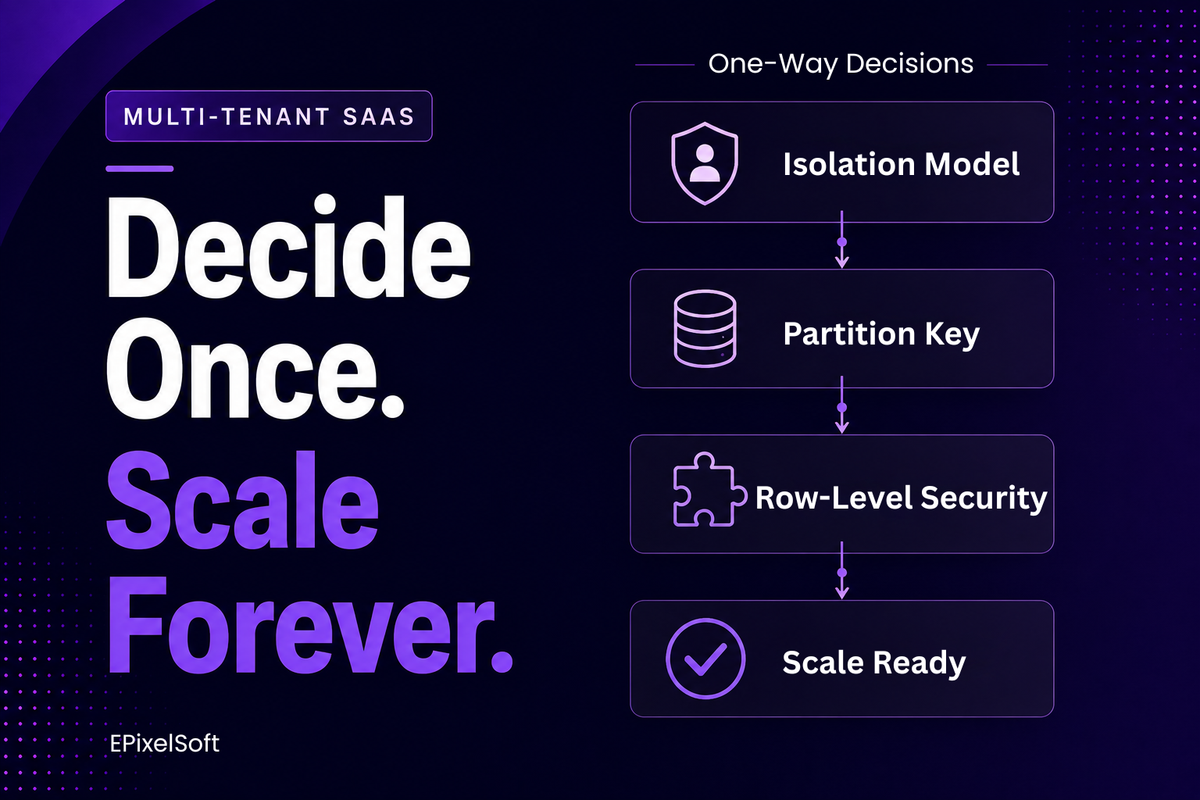
The models are not only cost tiers. Behind them sit a handful of decisions that behave like one-way doors. A one-way door is cheap to walk through on day one and brutally expensive to walk back through later. On day one you have no tenants and no data, so every model works in a demo. The bill for the decision arrives at the worst possible moment: when a compliance review, an enterprise contract, or a performance complaint forces you to change the foundation while the product is live and paying your salaries.
We build these systems for funded founders and SaaS teams, and the pattern repeats. The architecture that comfortably carried the first 50 tenants starts to crack somewhere around 500. This post is about which decisions cause that, and how to tell the ones you can defer from the ones you cannot.
The Isolation Model Is a Business Decision Wearing a Database Costume
There are three common isolation models. Pooled means all tenants share the same tables, separated by a tenant_id column. Bridge means one shared database but a separate schema per tenant. Silo means a dedicated database per tenant. In 2025 and 2026, the standard way to enforce the pooled model is PostgreSQL Row-Level Security, which filters every query to the current tenant's rows at the database layer instead of relying on the application to add the right WHERE clause each time.
Pooled is the cheapest to run and the default for most seed-stage B2B SaaS products, which is a reasonable place to start. The trap is treating the choice as purely about cost and efficiency. Your isolation model also sets your compliance ceiling. It is the highest level of data separation you can promise a customer without re-architecting. When your first regulated buyer in finance or healthcare asks for contractual, physical data separation, a product built pooled-only cannot say yes. It can only say "give us six months."
The One-Way Doors, and What Walking Back Through Them Costs
Migrating from pooled to silo is not a config change. It means physically separating data that was designed to be commingled: re-homing every tenant's rows into dedicated databases, rewriting the connection logic behind every query, and rebuilding your deployment and migration tooling to operate across a fleet of databases instead of one. Going the other direction, silo to pooled, is arguably worse, because you are merging schemas that drifted apart independently and retrofitting isolation onto data that never had any.
About The Author

EPixelSoft Team
LinkedInThe EPixelSoft engineering team has spent 12 years building production software for organizations where the stakes are high — FinTech lenders, HealthTech platforms, international NGOs, and funded SaaS startups across the US, UK, Africa, and Asia. With 700+ systems shipped and a proprietary AI platform running in the field, the team writes from direct delivery experience: what breaks in production, what actually works, and what the vendor pitch never tells you.