How to Hire an AI-Native Software Company: Questions That Separate Real From Marketing


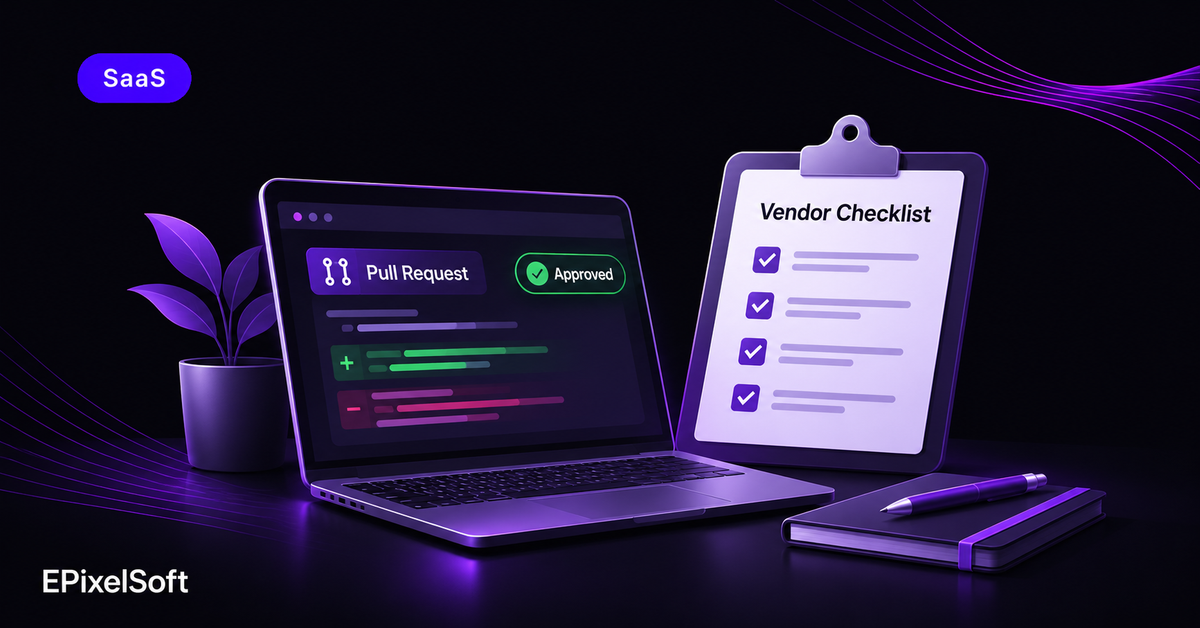
To hire an AI-native software company, ask where AI sits in delivery, who reviews AI-written code, how the estimate changed, and who owns the result. Stack Overflow's 2025 survey found 84% of developers use or plan to use AI tools, so the claim alone proves nothing. For founders and fintech buyers commissioning a SaaS product, the reliable signals are a named reviewer, a written security process, and evidence from systems already in production.
Every software agency now calls itself AI-native. The phrase has no standard definition, no certification, and no way for a buyer to verify it from a website. A founder comparing five proposals reads the same sentence five times.
The claim can fail in two directions. A vendor may use AI carelessly, which is a delivery risk that shows up as breaches and rewrites. Or the vendor may use it barely at all, which is a pricing risk, because you pay a traditional rate for a label.
This is a vetting guide from a firm that answers these questions for a living. Put every one of them to us as well.
Why “We Use AI” Tells You Nothing
Adoption is no longer a differentiator. Stack Overflow's 2025 Developer Survey, covering more than 49,000 developers, found 84% using or planning to use AI tools, up from 76% a year earlier. Google's 2025 DORA report, based on nearly 5,000 professionals, put adoption near 90%. Your whole shortlist uses AI. What differs is what surrounds it.
DORA's central finding was that AI acts as an amplifier. Adoption now correlates with higher delivery throughput, and it still correlates with higher instability, meaning more failed changes and more rework. A team with sound review and testing habits gets faster. A team without them ships its problems sooner. The Stack Overflow survey adds that 46% of developers distrust the accuracy of AI output, against 33% who trust it. Healthy teams treat that distrust as a process requirement.
Speed claims deserve the same scepticism. In a 2025 randomized trial, METR found that experienced developers took 19% longer with AI tools on codebases they knew well, while believing they had been 20% faster. METR says the result reflects early-2025 tools, and its 2026 follow-up leaned toward a speedup while warning that its own data was unreliable. The lesson that survives is that how fast a team feels is not how fast it is. A vendor promising ten times the speed is reporting a feeling.
About The Author

EPixelSoft Team
LinkedInThe EPixelSoft engineering team has spent 12 years building production software for organizations where the stakes are high — FinTech lenders, HealthTech platforms, international NGOs, and funded SaaS startups across the US, UK, Africa, and Asia. With 700+ systems shipped and a proprietary AI platform running in the field, the team writes from direct delivery experience: what breaks in production, what actually works, and what the vendor pitch never tells you.