Unitree's IPO Debut Shows Physical AI's Real Opportunity Is Software


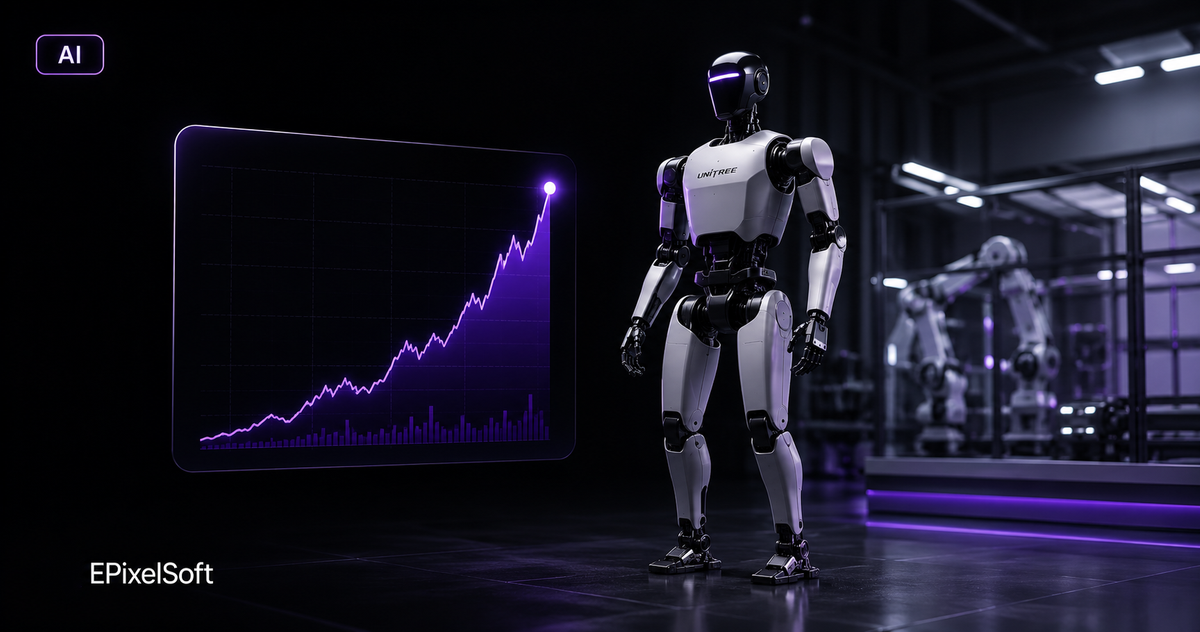
Unitree Robotics closed its first day of trading on Shanghai's STAR Market up 460 percent, after shares opened as high as 629 percent above the IPO price. According to Bloomberg's reporting on the August 19, 2026 listing, the close gave the Hangzhou-based humanoid robot maker a market value of about 342 billion yuan, roughly $48 billion, on an IPO that raised $904 million. The retail portion of the offering was oversubscribed nearly 8,000 times, according to Reuters and CNBC coverage of the debut. Unitree is also, unusually for this category, profitable. Caixin Global reported 2025 revenue of 1.7 billion yuan and net profit of 278 million yuan, a real business result sitting underneath a valuation trading at more than 850 times projected earnings.
The headlines will focus on the robots: the dancing G1, the backflips, the martial arts demo that made Unitree a household name in China. But the number that should matter more to software teams is buried under the hardware story. Grand View Research projects the software segment of the humanoid robot market will grow at a compound annual rate above 45 percent through 2033, even as hardware still accounts for roughly 79 percent of category spend today. Hardware is where the capital is going right now. Software is where the growth curve is steepest.
That gap matters because most software companies are reading this IPO the wrong way. They see a robotics story and conclude it is not their market. It is closer to the truth to say the opposite. A Unitree, a Figure AI, or an Agility Robotics is a hardware platform waiting for a software layer that most robotics companies are not fully equipped to build alone, and most software companies have not yet realized they are qualified to build.
The Hardware Is the Easy Part to Buy. The Software Is the Hard Part to Build
This is not a claim that hardware is trivial. Actuators, batteries, and dexterous hands are genuinely difficult engineering problems, and Unitree's manufacturing scale, more than 5,500 humanoids shipped in 2025 and roughly 18,000 units across its full product range by mid-2026 according to Forbes' reporting on the IPO, is a real moat. But once a company can buy or lease a capable robot body through a platform like Unitree, Figure, Boston Dynamics, or Agility, the constraint shifts immediately to what that body can actually do inside a specific warehouse, hospital, or factory floor.
NVIDIA's own framing of the category makes this explicit. Its Jetson Thor platform, now running in production for 1X, Agile Robots, Amazon Robotics, Boston Dynamics, FANUC, and Hitachi, delivers up to 2,070 FP4 teraflops of on-device compute, purpose-built to run vision-language-action models locally rather than over a network connection a warehouse floor cannot always guarantee. The hardware vendor is not positioning the robot body as the product. It is positioning the compute as the platform for whatever software a team builds on top of it.
About The Author

EPixelSoft Team
LinkedInThe EPixelSoft engineering team has spent 12 years building production software for organizations where the stakes are high — FinTech lenders, HealthTech platforms, international NGOs, and funded SaaS startups across the US, UK, Africa, and Asia. With 700+ systems shipped and a proprietary AI platform running in the field, the team writes from direct delivery experience: what breaks in production, what actually works, and what the vendor pitch never tells you.