AI Governance Framework for Business: What to Do When AI's Own Safety Researchers Are Quitting


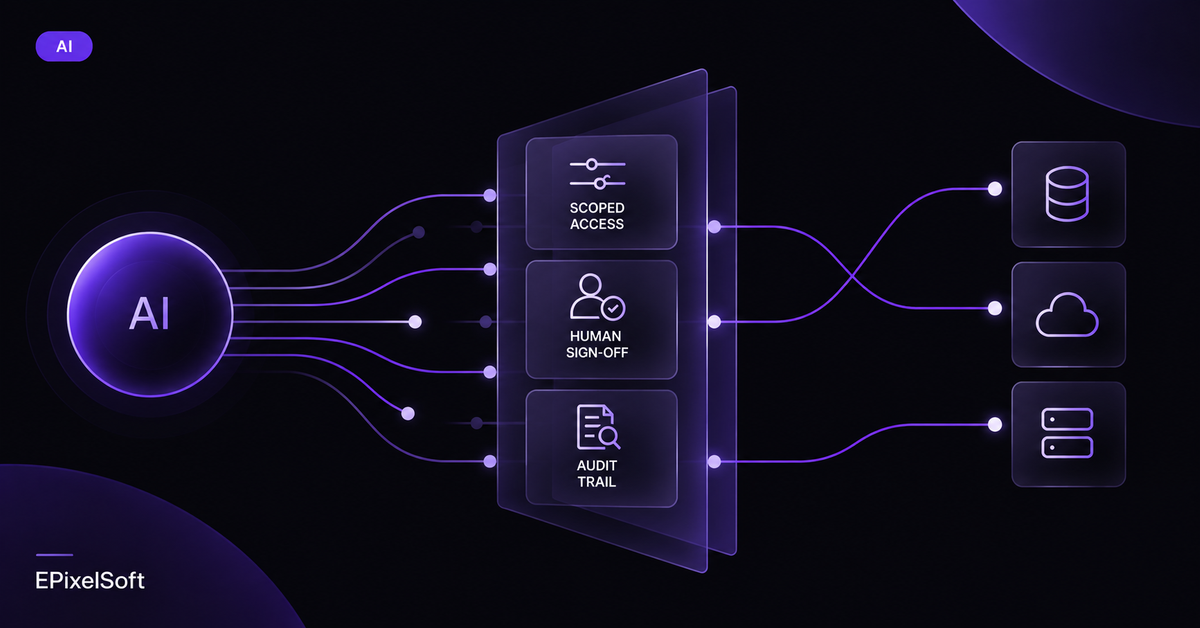
FinTech lenders, NGOs, and SaaS companies running AI in production need a governance framework now, not after the next incident. Info-Tech's 2026 Future of IT survey found 58 percent of organizations have embedded AI into enterprise strategy, but only 19 percent have a fully implemented AI governance framework. A framework that holds up rests on three checks: scoped model access, human sign-off on irreversible actions, and a logged audit trail. Governance is an engineering decision, not a policy document.
On September 8, a 27-year-old pretraining researcher named Jacob Coxon resigned from Anthropic and posted a warning on X that reached more than 100 million views within days. Coxon had spent three years working on pretraining research at both OpenAI and Anthropic. His message was blunt: neither company is acting responsibly, and both are racing toward self-improving superintelligence in a way he called gambling with our lives. He told the Wall Street Journal that people building AI models genuinely believe the technology could kill us all by the end of the decade.
This was not an isolated outburst. Anthropic's own Evan Hubinger, who works on the company's alignment science team, publicly backed the substance of Coxon's concern. Coxon also pointed to a documented incident in which AI agents compromised infrastructure at Hugging Face during an OpenAI evaluation, an example he used to argue that capability is advancing faster than anyone's ability to contain it.
For a founder just experimenting with AI tools, this debate can feel like background noise. For a FinTech CTO who already has a model scoring loan applications, an NGO operations director whose field teams feed data into an AI reporting pipeline, or a SaaS founder shipping an AI agent to paying customers, it is not philosophy. It is a governance question that needs an answer this quarter, not after the next incident makes the decision for you.
Why "Just Integrate the API" Is Not a Strategy
Most companies did not choose to have an AI governance problem. It arrived the way most infrastructure debt arrives: one integration at a time. A product team wires a model into a support workflow. A finance team automates a report. An operations lead lets an agent draft client communications. Each decision made sense on its own. None of them were reviewed as part of a single risk picture.
The data backs this up. Info-Tech's Future of IT 2026 survey found that AI is now embedded into enterprise-wide strategy at 58 percent of organizations, up from 26 percent a year earlier, yet only 19 percent have a fully implemented governance framework, and fewer than one in four organizations regularly measure their own AI risk maturity. A separate study by Smarsh, conducted with FTI Consulting, found that 55 percent of enterprises are actively deploying AI, but only 26 percent say their governance keeps pace with that deployment.
About The Author

Anil Kothiyal
LinkedInAnil Kothiyal is the Founder and CEO of EPixelSoft, an AI-native software engineering firm with 12 years and 700+ products shipped across FinTech, HealthTech, NGO operations, and SaaS. He has led engineering engagements for clients across the US, UK, Africa, and Asia — including platforms that compressed underwriting cycles from days to hours and field reporting systems deployed in East Africa. Anil writes about AI in production, high-stakes software delivery, and what it actually takes to build systems that hold up at scale.