Designing Offline-First Mobile Apps for Remote Field Work and Disaster Relief
EPixelSoft Team
|
28 Jul 2026
|
7 Min Read
Share
Offline-first mobile apps for NGOs, field agents and disaster relief teams stand or fall on three components: a local database that owns the write, a durable outbox of intents with client-generated IDs, and a conflict policy decided per field rather than per app. During Hurricane Helene, FCC data showed 48.7 percent of cell sites out of service across affected North Carolina counties. Software for that environment treats the network as an occasional visitor.
Most teams building for field conditions reach the offline-first decision quickly. The hard part starts the day after, when someone specifies what happens to a beneficiary record edited by two enumerators, on two devices, eleven days apart, one of whom had the wrong date on the phone.
That is the actual work. Not the decision, the semantics.
The scale is not marginal. KoboToolbox, the most widely used data collection platform in humanitarian emergencies, reports that its users submit more than 20 million surveys a month, largely from Android devices in low-connectivity settings. Each is a write that had to survive a gap between capture and server.
The failure mode is one bar, not zero bars
Complete absence of signal is the easy case. The device knows, the app knows, the code path is clean. According to the GSMA's State of Mobile Internet Connectivity 2025, 96 percent of the world's population now lives inside mobile broadband coverage, leaving roughly 300 million people outside it entirely. Most field teams work inside that 96 percent, which is where the difficult engineering lives.
Degraded connectivity is worse than none, because everything reports success and nothing completes. The device shows a bar. The socket opens. The request hangs for ninety seconds and dies after the enumerator has walked to the next household. Captive portals at a district office return HTTP 200 with a login page instead of your API response.
Disaster conditions push this further. FCC Disaster Information Reporting System data during Hurricane Helene recorded 48.7 percent of cell sites out of service across the affected North Carolina counties. A published survey of the 2023 Turkiye earthquake estimated that up to 60 percent of the mobile network in the hardest-hit regions was initially non-operational, with internet traffic in Kahramanmaras province dropping 94 percent after the second quake. Coverage on a map is not coverage on the day you need it. The design target is therefore not a binary online flag but a spectrum: absent, intermittent, degraded and expensive.
The EPixelSoft engineering team has spent 12 years building production software for organizations where the stakes are high — FinTech lenders, HealthTech platforms, international NGOs, and funded SaaS startups across the US, UK, Africa, and Asia. With 700+ systems shipped and a proprietary AI platform running in the field, the team writes from direct delivery experience: what breaks in production, what actually works, and what the vendor pitch never tells you.
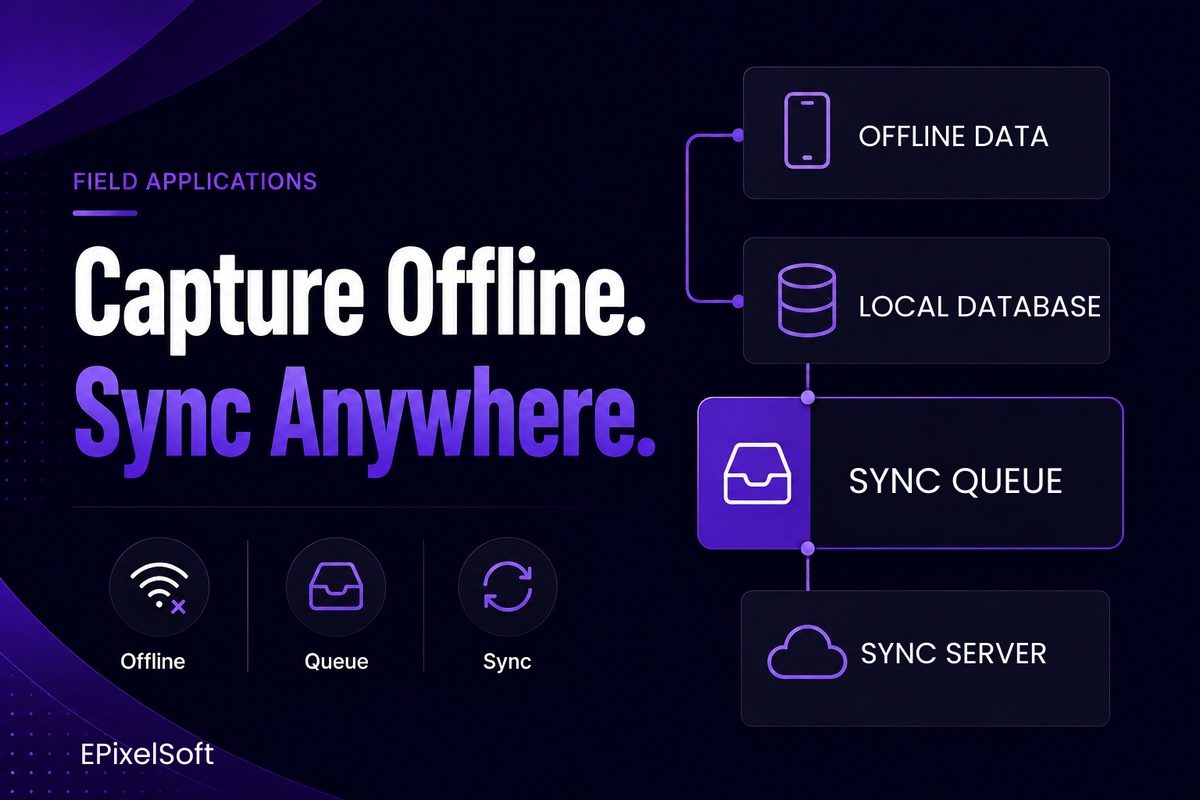
Every serious offline-first system converges on the same shape. The local database owns the write. A durable queue records what the user did. A background worker drains that queue when conditions allow, while a separate path pulls remote changes down.
Android's own offline-first architecture guidance states the rule plainly: write to the local data source first, then queue the write to notify the network at the earliest opportunity. The important word is durable. The queue lives on disk, in SQLite or Room or Core Data, and survives an app kill, a battery pull and a forced update. An in-memory queue is a demo.
Two decisions inside that queue determine how much pain arrives later. The first is queueing intents rather than snapshots. Recording "set household size to 7" produces a small, deterministic operation that replays cleanly and collides rarely. Recording the whole record as it looked on the device produces a blob that overwrites whatever else happened while that device was dark. Operation-based sync shrinks payload size and conflict surface together.
The second is client-generated identifiers. Every record created offline gets a UUID minted on the device, and every queued operation carries an idempotency key. Without this, a request that succeeds server-side and fails to return an acknowledgement gets retried, and a household is registered twice. Retries are not an edge case in the field, they are the normal path, so the API contract has to make a repeated write harmless.
Media deserves its own queue. A survey record is a few kilobytes and its geotagged photos are several megabytes, so one queue means a single upload on a 2G link blocks a hundred records behind it. Separate them, prioritise the structured data, and let images drain on a policy the organisation controls.
Conflict resolution is a policy decision made field by field
Most published guidance stops at a fork: last-write-wins is simple, CRDTs are correct, choose according to your domain. That is where the useful part begins, not ends.
The question to ask for each field is what a wrong merge costs. Last-write-wins is fine for a note a supervisor may overwrite. It is not fine for a distribution tally, where two agents each recording forty units delivered should produce eighty, not forty. Counters need addition, not replacement, which is where a counter CRDT earns its complexity.
Identity fields need a third answer, which is refusal. If two devices disagree about a beneficiary's name, date of birth or registration number, no automatic rule should pick a winner. Hold both versions, flag the record, route it to a human. Silent merging of identity data in aid delivery is how duplicate registrations and exclusion errors enter a programme, and neither shows up in a test suite.
Status transitions want a state machine rather than a timestamp. If a case moves from screened to enrolled to closed, a stale update trying to move it backwards should be rejected on the transition rule, whichever clock claims to be later. That matters because device clocks in the field are frequently wrong. A phone off the network for two weeks, factory reset, or manually adjusted by its user cannot be trusted to order events. Server-assigned sequence numbers or hybrid logical clocks make ordering defensible. Last-write-wins built on device time is a bug waiting for an audit.
What holds up on a real deployment
Sync state has to be visible. Queued, syncing, synced and failed are four different things, and an agent who cannot tell them apart will either re-enter data already saved or walk away from data that never left the phone. An indeterminate spinner communicates nothing. A record count with a status does.
Schema migration bites hardest and gets planned least. A device returning after six weeks in a response may be three app versions behind, holding two hundred queued operations written against an older shape of the data. The client migration path and the server's tolerance for older payload versions both belong in the first release. Retrofitting that means asking field teams to discard unsynced work, which is the one thing they will not forgive.
Device loss is a data question, not only a hardware one. Unsynced records exist in exactly one place, so encryption at rest and a policy for a phone that disappears in a flood zone belong in the design, not the incident review. Test conditions have to be honest. Airplane mode is not a test. Throttled 2G with 40 percent packet loss, a request killed mid-flight, and a device clock set two days into the future are tests.
Buy the sync engine or build it
The tooling improved over the past two years. PowerSync, ElectricSQL, Zero, Turso Sync and CRDT extensions for SQLite all offer credible paths to local-first data without hand-rolling replication. For a straightforward domain with standard conflict rules, adopting one saves months.
The caveat is that practitioner write-ups through early 2026 keep landing on the same rough edges, particularly reconnection behaviour and partial-replication rules, which is where field conditions differ most from office ones. Where the domain carries audit requirements, per-field conflict policy or multi-system integration, a custom sync layer over local SQLite remains the more predictable option, and it is months of engineering rather than a sprint.
We built this layer for Terriqon, our field data platform for construction, conservation and NGO programme teams, and the payoff shows in outcomes, not architecture diagrams. For an NGO across East Africa, moving programme capture onto an offline-first pipeline brought donor reporting from weeks to minutes. That came from the sync design, not the reporting screen. More sit in our case studies.
Design for the worst hour, not the average day
The average day in most field programmes has usable connectivity somewhere, at some point. Software built to that average works in the pilot district and fails in the week that matters, when a storm takes half the towers out or a team moves into a valley with no service for nine days.
Building for the worst hour costs more up front and produces an app that is boring in good conditions and functional in bad ones. For relief and remote field work, that trade is not close.
If you are scoping a field application, or repairing one where sync is already losing records, talk to our engineering team about the conflict policy before anyone designs a screen.
EPixelSoft is an AI-native software engineering company based in Noida, India. Since 2014, we have shipped 700+ production systems across FinTech, HealthTech, NGO operations, and SaaS.