Building Audit-Proof Financial Pipelines: Microservices Architecture for High-Volume Ledger Systems
EPixelSoft Team
|
27 Jul 2026
|
7 Min Read
Share
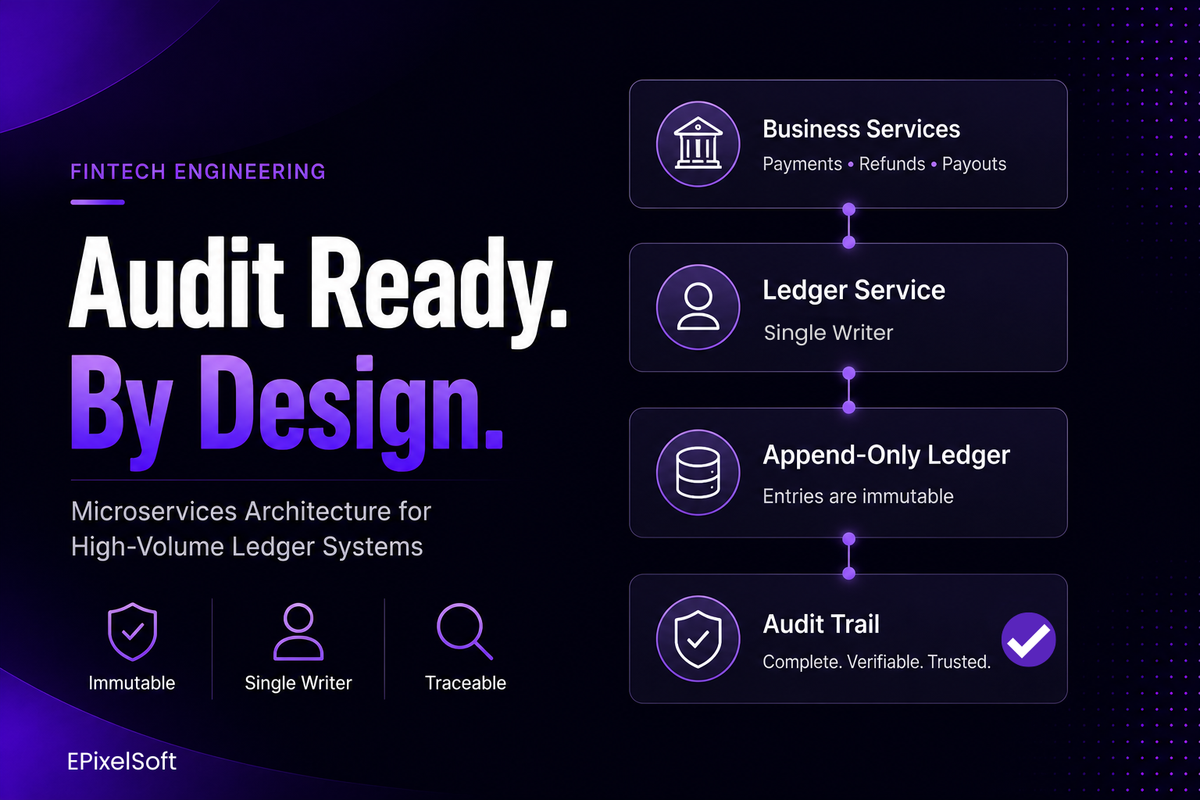
An audit-proof financial pipeline rests on three architectural rules: the ledger is append-only and balances are derived from entries rather than stored, exactly one service is permitted to post to it, and every posting request carries an idempotency key enforced by a database constraint. Uber's LedgerStore holds hundreds of billions of ledger records under cryptographically verifiable immutability. FinTech and SaaS platforms that skip these rules discover the gap during their first audit.
Most financial pipelines begin with a column called balance and a statement that decrements it. That works until the first duplicate webhook, the first partial refund, or the first auditor who asks what the balance was on 14 March at close of business.
Audit-proof does not mean heavily logged. It means every number can be reproduced from primary records, every change is attributable, and nothing can be quietly altered after the fact. Those are architectural properties, and a compliance workstream cannot add them later.
The cost lands on the finance team rather than engineering, which is why it stays invisible for so long. A PwC global finance survey found that finance professionals spend 30 to 40 percent of their time on transactional activities such as reconciliation. The AICPA's 2025 Firm Operations Benchmarking Report put manual bank reconciliation at 22 percent of total capacity for teams of 10 to 50 staff. That is the tax a weak ledger levies every month.
A balance column is a cache, not a fact
The entries are the facts. The balance is derived, computed as the sum of entries against an account. Once you accept that inversion, most of the hard questions answer themselves, because history is no longer something you bolt on.
Double-entry supplies the invariant that makes the system testable. Every movement of value posts at least two entries, a debit and a matching credit, and the sum of all debits equals the sum of all credits across the ledger at all times. That is not accounting ceremony. It is a continuously checkable assertion that money was not created or destroyed by a bug. A single-entry system has no equivalent, so when a balance drifts there is nothing to compare it against.
Immutability is the second half. Entries are never updated or deleted, and a correction is a reversing entry plus a new posting, leaving the mistake and its repair both visible. This is what large operators build toward. is an append-only store holding hundreds of billions of records with cryptographic verification that nothing has been altered, backing tens of billions of financial transactions a quarter.
The EPixelSoft engineering team has spent 12 years building production software for organizations where the stakes are high — FinTech lenders, HealthTech platforms, international NGOs, and funded SaaS startups across the US, UK, Africa, and Asia. With 700+ systems shipped and a proprietary AI platform running in the field, the team writes from direct delivery experience: what breaks in production, what actually works, and what the vendor pitch never tells you.
One number from Uber's migration write-up is worth keeping. At 11 nines of storage durability, you should still expect roughly 10 corrupted records per trillion. At volume, silent data loss is a statistical certainty rather than a possibility, which is the argument for verification that runs continuously instead of a backup nobody has restored.
In a microservices estate, the ledger has exactly one writer
The distributed systems problem in financial software is rarely the ledger schema. It is that eight services believe they are entitled to move money.
The rule that holds is that they are not. Other services request a posting; the ledger service performs it. Balance mutation lives behind one boundary, with one code path, one set of validations and one place where the invariant is enforced. Billing, refunds, payouts and fee calculation become clients of that service rather than co-owners of the truth.
That boundary rules out a distributed transaction spanning the ledger and the calling service, which is the right outcome, because two-phase commit across services is a reliability liability. The workable pattern is a transactional outbox: the business service commits its state change and an outbound event in one local transaction, a relay publishes the event, and the ledger posts from it. When a downstream step fails, you compensate with a reversing entry rather than rolling back a posting other systems have already read.
Idempotency has to be structural. Every posting request carries a caller-supplied key, and that key sits under a unique constraint in the ledger database. An application-level check that queries for an existing transaction before inserting will eventually lose a race and post twice. The constraint will not. Retries are the normal condition of any queue-driven pipeline, so a duplicate posting request has to be a no-op by construction.
Money types deserve the same rigour. Amounts are integers in minor units, never floating point, and currency travels with the amount as part of the type rather than a column somebody forgets to filter on. Rounding policy is declared once, applied in one place, and any residual is posted to a rounding account so debits and credits still net to zero. A pipeline that lets rounding vanish has broken its own invariant to save a line of code.
Real-time monitoring means watching the invariant, not the error rate
Most transaction monitoring dashboards report on infrastructure. Request latency, queue depth, error percentage. Useful, and blind to the failure that matters, which is a system that is fast, green and quietly wrong.
The signals worth alerting on are accounting signals. The trial balance across the ledger should net to zero on every evaluation, and a non-zero result is a page, not a ticket. Clearing and suspense accounts should drain within a defined window, so a balance that ages past it means value is stuck between two systems. The delta between the internal ledger and each processor statement should be computed continuously rather than assembled at month end.
That last shift is where the reconciliation tax falls. When the comparison against external sources runs monthly, every discrepancy arrives as archaeology across thirty days of activity. When it runs every few minutes, a mismatch surfaces alongside the deploy or upstream format change that caused it. The engineering work is the same either way. The difference is where in the pipeline it sits.
What auditors actually ask for
Auditors do not ask to see your logs. They ask three questions most systems answer badly. Reproduce this balance as of a specific date and time. Show every change to this record, in order, and who or what made each one. Demonstrate that nothing was removed.
An append-only ledger with derived balances answers all three by construction. As-of balances come from summing entries up to a timestamp, or from periodic snapshots plus a delta if performance requires it. Attribution comes from stamping every entry with its actor, source event and originating request. Completeness comes from gapless sequence numbers, and from hash chaining if the risk profile warrants it. A system built on mutable rows and application logs answers with an argument rather than a query, and arguments are expensive during an audit.
There is a live deadline attached to this. Following the end of the SWIFT MT coexistence period in November 2025, ISO 20022 carries considerably richer structured payment data, and from November 2026 structured or hybrid address formats become the minimum on cross-border rails, with non-conforming payments liable to rejection or delay. Pipelines that truncate fields to fit a legacy schema now fail in production rather than merely losing information.
The expensive part is the migration, not the ledger
Building a correct double-entry ledger for a new product is contained work. Retrofitting one onto a live platform that has decremented a balance column for three years is the hard project, because the history has no entries to reconstruct from and current balances are the only surviving record.
The approach that works is parallel running. Stand up the ledger, open every account with a single opening-balance entry derived from the current figure, post to both systems for a period, and reconcile continuously until the new ledger has earned the right to become authoritative. Slower than a cutover, and the only version that does not put a quarter's numbers at risk.
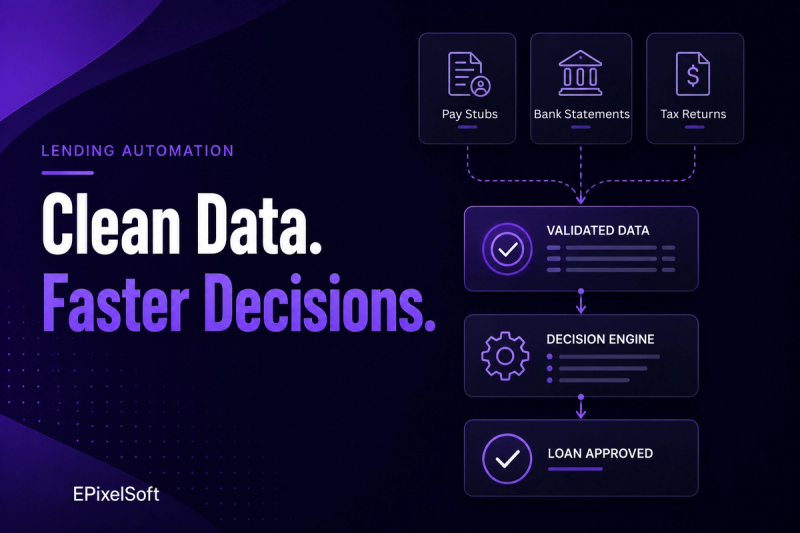
We have run this pattern in lending and payments work. For a US commercial lending company, rebuilding the document and decision pipeline around verifiable state cut analyst time by a factor of four and raised revenue per analyst tenfold, with the audit position improving as a side effect. More sit in our case studies.
Correctness you can query beats correctness you can argue
The reason to build this way is not regulatory box-ticking. A ledger with a live invariant tells you within minutes when something has gone wrong. A system without one tells you at quarter end, through a finance team that spent three weeks finding it.
The architecture is old and well understood. Double-entry has been the answer since the fifteenth century. What modern engineering adds is enforcement at machine speed and volume, which is what a high-volume pipeline needs.
If you are designing a ledger, or carrying one that reconciles badly, talk to our engineering team about the invariants before the schema.
EPixelSoft is an AI-native software engineering company based in Noida, India. Since 2014, we have shipped 700+ production systems across FinTech, HealthTech, NGO operations, and SaaS.