AI Workflow Automation for Teams: Why Task Speed Is Not Team Speed
Anil Kothiyal
|
23 Jul 2026
|
7 Min Read
Share
AI workflow automation makes a team faster only when it removes a queue, not when it speeds up a task. Google's DORA research found that AI adoption raises delivery throughput and delivery instability at the same time, and that 90 percent of technology professionals now use AI daily. FinTech and SaaS teams that measure keystroke-level gains cannot show a throughput change. Cycle time, measured from request to delivered outcome, is the number that survives a CFO review.
Every engineering leader we speak to is holding two facts that do not fit together. Their team uses AI every day. Their delivery calendar looks about the same as it did a year ago.
Adoption is not the problem. Google's DORA team surveyed nearly 5,000 technology professionals for its 2025 State of AI-assisted Software Development report and found that 90 percent now use AI in daily work, with more than 80 percent reporting a productivity increase. The same research found that AI adoption raises software delivery throughput and software delivery instability together, and has no measurable effect on friction or burnout.
The gap is not in the models. It sits in the definition of faster that most teams are using. Task speed and team speed are different measurements, and only one of them shows up on a P&L.
The time you save on a task does not leave the building
Start with the uncomfortable study. In July 2025, the nonprofit research group METR ran a randomised controlled trial with 16 experienced open-source developers across 246 real tasks in repositories they already knew well. The developers predicted AI would make them 24 percent faster. Measured completion times showed they were 19 percent slower. After finishing, those same developers still estimated AI had sped them up by 20 percent.
METR has since labelled that result historical, and its February 2026 follow-up showed some evidence of speedup that was complicated by selection effects. The percentage was never the useful part. The useful part is the distance between what the developers felt and what the clock recorded. Self-reported speed is not evidence of speed.
Anil Kothiyal is the Founder and CEO of EPixelSoft, an AI-native software engineering firm with 12 years and 700+ products shipped across FinTech, HealthTech, NGO operations, and SaaS. He has led engineering engagements for clients across the US, UK, Africa, and Asia — including platforms that compressed underwriting cycles from days to hours and field reporting systems deployed in East Africa. Anil writes about AI in production, high-stakes software delivery, and what it actually takes to build systems that hold up at scale.
There is a mechanical reason for the gap. DORA's ROI of AI-Assisted Software Development report, published in January 2026, describes a verification tax: time saved during creation gets reallocated to auditing and reviewing what was generated. Research from Stanford's Software Engineering Productivity programme, cited in that report, puts gains at 35 to 40 percent on simple greenfield work and often at 10 percent or less on complex legacy code. Most commercial software work is the second kind.
The saved minutes are real. They just do not leave the system. They move from writing to checking, from one calendar to another, and the elapsed time between a request and a delivered outcome stays roughly where it was.
Cycle time is the only number that survives a CFO conversation
Take a commercial loan file. The analyst work inside it might be 90 minutes. The file still takes nine days to reach a credit decision. Ninety minutes is task time. Nine days is cycle time, and almost all of the difference is waiting. Sitting in a queue. Waiting for a missing document. Waiting for a second reviewer. Going backwards through a rework loop because something was wrong at intake.
Halve the 90 minutes and the nine days barely moves. That is the whole story of AI programmes that produce enthusiastic users and no measurable business result. MIT's Project NANDA reported in its GenAI Divide study that 95 percent of enterprise generative AI pilots delivered no measurable P&L impact, drawing on an analysis of 300 public deployments. Deloitte's 2026 enterprise AI outlook names the cause more precisely: nearly half of the organisations making changes are adding AI without redesigning the process it sits inside.
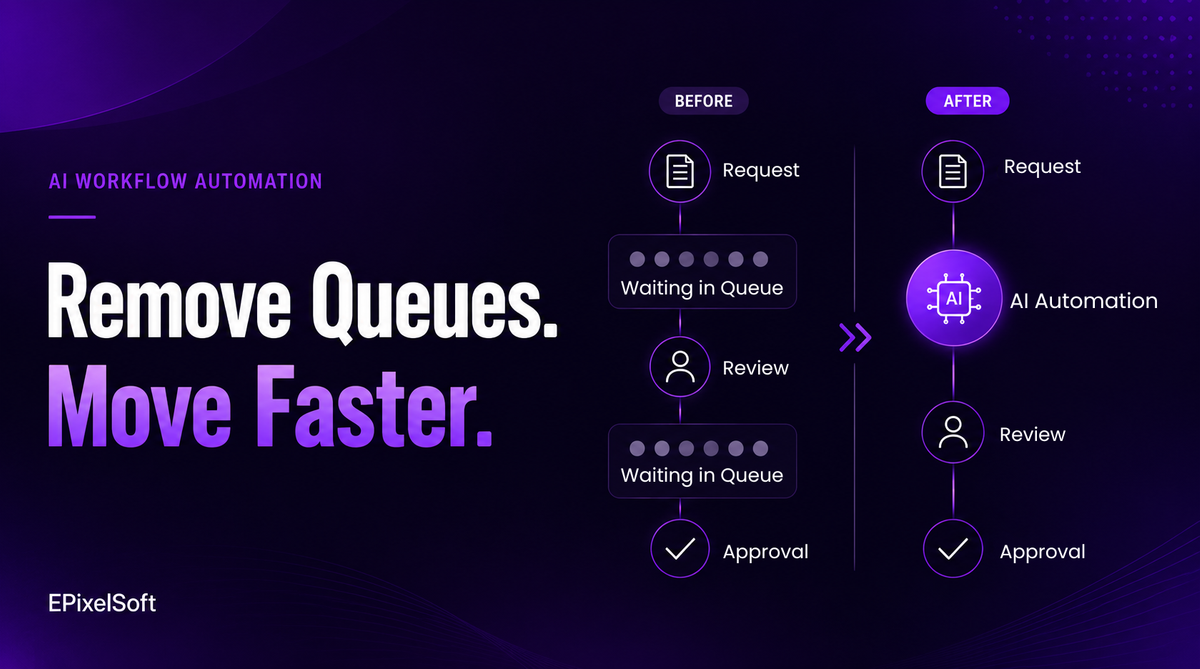
AI moves cycle time in four ways, and none of them involve making a person type faster. It removes a handoff, so work stops changing hands. It removes a wait for a scarce specialist, by putting a judgement at the point of entry instead of three days downstream. It kills a rework loop, by catching a defect when work enters the system rather than when a reviewer finds it. And it turns a request into a self-serve step, so the request never joins a queue at all.
The DORA team put the principle in one line worth stealing. "We don't measure AI by the code it writes but by the bottlenecks it clears."
Finding that constraint is less sophisticated than it sounds. Write down every step a unit of work passes through, then record two numbers per step: how long the work is actively touched, and how long it sits. In most processes we audit, the sitting time is between five and twenty times the touching time. The steps with the longest sitting time are where AI is worth spending money. Everywhere else, it produces a better experience for the person doing the step and no change anyone above them can see.
That reframing changes what you build. If the constraint is a two-day wait for compliance sign-off, a faster drafting tool does nothing. If the constraint is that a third of submissions arrive incomplete, validation at intake is worth more than any model upgrade further down the line.
What this looked like inside an underwriting workflow
A US commercial lending company came to us with what they described as an analyst capacity problem. They wanted the team to get through files faster. When we mapped the actual sequence, reading speed was not the constraint. The constraint was how many times a file changed hands, and how often it went backwards because a document was missing or a number did not reconcile.
So we rebuilt the sequence instead of the task. Document extraction and validation moved to intake, so an incomplete file surfaced within minutes rather than on day four. Financial spreading became a generated draft with the analyst as reviewer rather than author. Exceptions routed straight to a senior underwriter instead of queuing behind routine files. The model work was the least interesting part of the build. Routing logic and validation rules did most of the heavy lifting.
The outcome was a four times reduction in time per file and close to ten times the revenue per analyst. The same pattern held on a completely different problem. An NGO in East Africa was spending weeks assembling donor reports out of field data. We collapsed the assembly step, and reporting moved from weeks to minutes. In both cases the win came from deleting steps, not accelerating them.
What it actually takes to move the number
Three things, in order.
Get a baseline first. You cannot claim a cycle time improvement without a before number, and most teams do not have one. Instrument the workflow for a few weeks before introducing anything into it. This is unglamorous, and it is the difference between a business case and a feeling.
Budget for the dip. DORA describes a J-curve of value realisation, a temporary productivity drop caused by the learning curve, the verification tax, and downstream processes that were never designed for this volume of output. The report treats that period as the price of the transition. Leaders who read the dip as failure tend to pull funding shortly before the return arrives.
Scale review capacity alongside generation capacity. DORA's own ROI model shows what ignoring this costs. In their sample calculation, a change failure rate rising from 5 percent to 6 percent after AI adoption produces $344,000 in downtime cost. Putting more work in front of a review gate that has not changed does not make a team faster. It builds a longer line.
None of this requires a large programme. It requires knowing which step is the constraint before choosing what to build, which is the entire purpose of an AI readiness assessment done properly.
Then pick one workflow. Own it from request to outcome. Measure the elapsed time. Then go again with the next one.
The question worth asking your team on Monday
Ask which queue got shorter. Not which tools people like, not how many hours anyone feels they saved, but which specific workflow now takes less elapsed time from request to delivered outcome, and what the number was before.
If nobody can answer that, the organisation has better tools and the same speed. It is a fixable problem. It is not fixed by buying more tools.
EPixelSoft is an AI-native software engineering company based in Noida, India. Since 2014, we have shipped 700+ production systems across FinTech, HealthTech, NGO operations, and SaaS.