AI-Native vs AI-Assisted Development: What Actually Changes in Price and Timeline


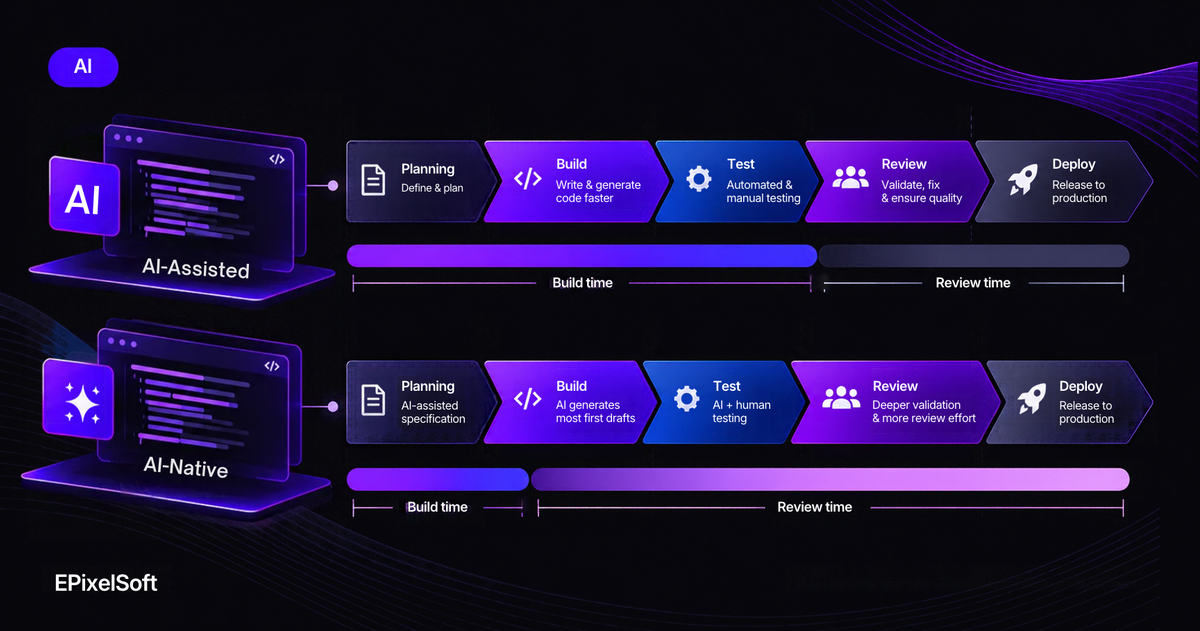
AI-assisted development adds AI tools to an unchanged process, so individual tasks get faster. AI-native development rebuilds specification, review, testing, and estimating around AI writing most first drafts. Faros AI's 2026 study of 22,000 developers found 66% more epics completed per developer under heavy AI use, alongside 243% more incidents per pull request. For SaaS and fintech buyers, the price effect is real but modest, because savings move from typing to verification.
Two labels now sit on most agency websites: AI-assisted and AI-native. They are often presented as a standard tier and a premium tier, and buyers are left to guess what either one changes in the invoice and the calendar.
The definitions themselves are not hard. In AI-assisted development, a developer works as before and uses AI for pieces of the job, such as completing a function or drafting a test. In AI-native development, the delivery process has been rebuilt on the assumption that AI writes most first drafts. Most vendor pages say roughly this, and they are right.
What they skip is the arithmetic. This post covers where time and money actually move when AI enters a software project, and how to read a quote with that in mind.
Why Faster Tasks Do Not Add Up to a Faster Project
The task-level evidence is strong. In November 2025, Anthropic analysed 100,000 real Claude conversations and estimated that AI cut task completion time by about 80%, on tasks that would otherwise take around 90 minutes. The study states plainly that it cannot see the time people spend afterwards validating the output.
That validation time is where the project-level data gets interesting. Faros AI's 2026 report followed two years of telemetry from 22,000 developers across more than 4,000 teams, comparing each organisation's lowest and highest periods of AI adoption. Under heavy use, epics completed per developer rose 66%. Bugs per developer rose 54%, incidents per pull request rose 243%, and 31.3% more pull requests were merged without any review. Faros also reports that 60% of AI-generated code is now accepted into codebases, up from 20% in its earlier dataset, so the tool has become the main author rather than an assistant. Faros calls the resulting pattern the Acceleration Whiplash. The data is correlational, and the direction is consistent.
Read together, the two studies describe one mechanism. AI makes producing code cheap and leaves the cost of trusting code where it was. A team that only adds tools pushes more drafts into a review system built for human pace, and the overflow shows up as rework, incidents, and slipped dates. The buyer pays for it either way.
About The Author

EPixelSoft Team
LinkedInThe EPixelSoft engineering team has spent 12 years building production software for organizations where the stakes are high — FinTech lenders, HealthTech platforms, international NGOs, and funded SaaS startups across the US, UK, Africa, and Asia. With 700+ systems shipped and a proprietary AI platform running in the field, the team writes from direct delivery experience: what breaks in production, what actually works, and what the vendor pitch never tells you.