AI Coding Costs Could Outpace Developer Salaries by 2028: What Gartner Got Right


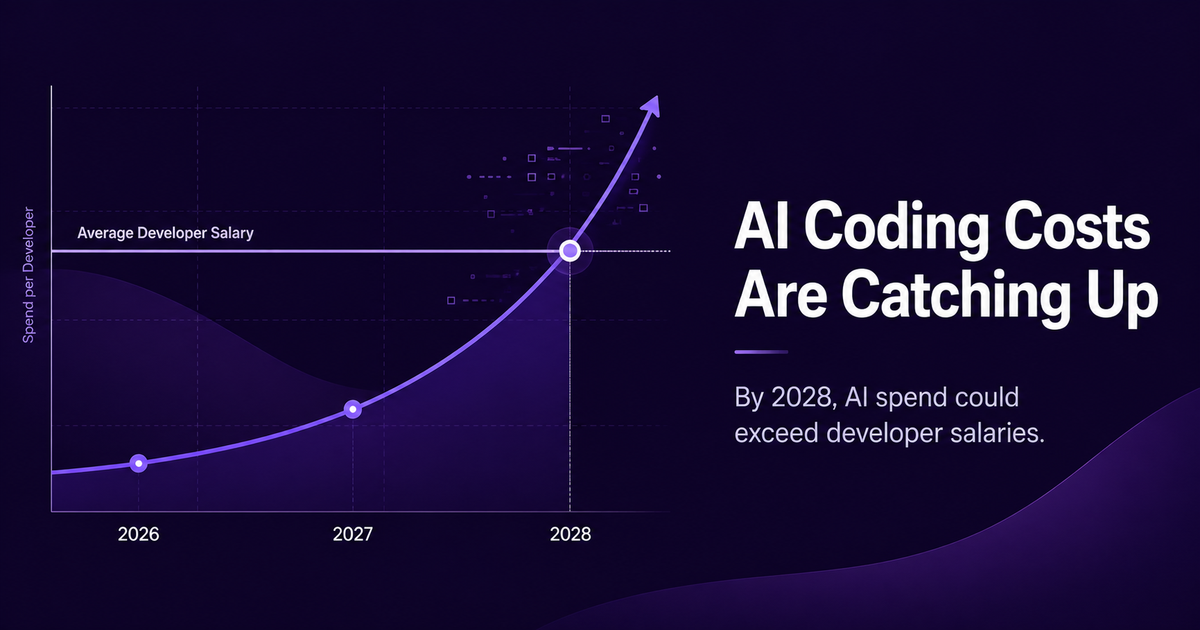
Gartner forecasts that by 2028, AI coding agent spend per developer will overtake the average developer's salary, driven by the shift from seat-based licenses to token-based consumption pricing. DevOps.com reports that nearly a quarter of technology leaders already pay $200 to $500 per developer each month in AI coding tokens, and 6% pay more than $2,000. For FinTech and SaaS engineering leaders, the fix is not fewer tools. It is governing how work gets scoped before an agent ever runs.
On June 24, 2026, Gartner told the market something that should have been obvious a year earlier: the cost of running AI coding agents is on a curve that developer salaries are not. By 2028, according to Gartner analyst Nitish Tyagi, spend per developer on AI coding tokens will overtake what that developer earns. Not because the tools got worse. Because the pricing model changed under everyone's feet, and almost nobody in the room was watching the meter.
The number that should worry engineering leaders more than the 2028 date is the one from right now. DevOps.com, citing Gartner's research, reports that nearly a quarter of technology leaders already spend $200 to $500 per developer per month on AI coding tokens. Six percent are already past $2,000 a month, per developer, for specialized workloads. That is not a subscription line item anymore. That is a second payroll, and it moves every month based on how the agents were used, not how many seats were purchased.
Most of the coverage that followed the Gartner release repeated the headline and stopped there. Fewer outlets asked the harder question: what actually determines how many tokens a coding agent burns to finish a task. The answer is not the model. It is the engineering process wrapped around the model, and that is a problem software leaders can fix well before 2028 arrives.
Seat-based budgeting was never built for this
The old math for a coding tool was simple. A developer license cost a fixed amount per month, whether that developer used it eight hours a day or barely opened it. Finance could forecast the line item a year out without thinking about it twice.
Consumption-based pricing broke that math on purpose. Computer Weekly reported that Gartner traced the shift directly to vendors moving from seat licensing to token-based billing, and warned that many providers give buyers limited visibility into how token usage is actually measured or charged. An agent that reads a repository, plans a change, writes code, runs tests, and iterates through failures is not one action. It can be dozens of model calls stacked inside a single developer request, and every one of them has a price.
About The Author

Anil Kothiyal
LinkedInAnil Kothiyal is the Founder and CEO of EPixelSoft, an AI-native software engineering firm with 12 years and 700+ products shipped across FinTech, HealthTech, NGO operations, and SaaS. He has led engineering engagements for clients across the US, UK, Africa, and Asia — including platforms that compressed underwriting cycles from days to hours and field reporting systems deployed in East Africa. Anil writes about AI in production, high-stakes software delivery, and what it actually takes to build systems that hold up at scale.