Agentic Payment Infrastructure for MCA Funders: What the Rails Can and Cannot Do
EPixelSoft Team
|
9 Oct 2026
|
6 Min Read
Share
Agentic payment infrastructure for merchant cash advance (MCA) funders is software that monitors merchant cash flow and adjusts collections inside contractual limits. Its strongest use is automated reconciliation, which courts weigh in a three-part test of whether an MCA is a sale or a loan. Its hard limit is the rails: RTP and FedNow are credit-push only, so daily collection still runs on ACH or processor splits. Policy-bounded agents work. Unbounded ones create legal exposure.
A merchant cash advance (MCA) funder buys a share of a merchant's future receivables and collects it daily. Collection is where the money is made and where the contract is most fragile. A fixed debit lands before the card settlement does, the merchant's account bounces, and an operations analyst spends the afternoon on a reconciliation ticket.
Agentic payment infrastructure is the proposed fix. Software agents watch cash flow, calculate each day's collection, and move money without a person in the loop. The idea is sound. Most of what gets published about it skips two facts that decide whether a build works: which payment rails can collect at all, and what an MCA contract lets a funder change on its own.
This post covers both, written for engineering and product teams at funders and at the platforms that serve them.
RTP and FedNow Push Money; Only ACH Pulls It
Many architecture diagrams show an agent collecting daily remittances over RTP or FedNow. That cannot work. Stripe's comparison of the two networks states that both are credit-push only, so a receiver cannot pull funds from an account. A fact sheet from Apex Fintech Solutions adds that payments on both are irrevocable and that neither offers debits, because of fraud risk. Canopy Servicing, writing for commercial lenders, points out that ACH is the only one of these rails that handles both push and pull.
Both networks do support request for payment. The funder sends a structured request and the merchant approves or rejects it. That suits an early payoff or a one-off true-up. As a daily collection method it gives the merchant a veto on every payment, which changes the product. Support also varies by provider: one banking API vendor's documentation says it does not yet offer request for payment over FedNow.
Instant rails still earn a place on the funding side. Pushing an advance to a merchant in seconds is exactly what credit-push does well. Collection is a different job.
The EPixelSoft engineering team has spent 12 years building production software for organizations where the stakes are high — FinTech lenders, HealthTech platforms, international NGOs, and funded SaaS startups across the US, UK, Africa, and Asia. With 700+ systems shipped and a proprietary AI platform running in the field, the team writes from direct delivery experience: what breaks in production, what actually works, and what the vendor pitch never tells you.
That leaves three realistic collection paths today: ACH debit under a signed authorization, processor-level split funding, and merchant-initiated push. Split funding is the older cousin of what agentic vendors describe. Clearent announced a service that routes a share of each merchant deposit directly to the MCA provider's bank account, and said funders prefer it to direct debit and lockbox. Stax offers an API that disperses a single payment to two accounts. The agent's job is to decide the percentage and the timing. It does not need a new rail to do that.
Reconciliation Is the Feature That Matters
Courts deciding whether an MCA is a sale of receivables or a disguised loan often start with a three-part test taken from LG Funding v. United Senior Properties of Olathe, a 2020 decision of New York's Appellate Division, Second Department. The questions are whether the agreement has a reconciliation provision, whether it has a finite term, and whether there is recourse if the merchant files for bankruptcy.
Reconciliation draws the most litigation. Commentary from MCA litigators notes that a clause saying the funder may adjust payments leaves the funder with discretion, and that discretion can make repayment look absolute. In one New York ruling, a monthly limit on reconciliation requests was found improper because it blocked a second adjustment during a continuing downturn. Bankruptcy courts, according to one practice analysis, ask a broader question: who bears the risk of non-payment?
That reframes what the agent is for. Daily collection that tracks real inflow is what the contract promises, but when people handle reconciliation by email and spreadsheet it is slow, uneven, and sometimes ignored. An agent that recomputes the remittance from verified deposits, applies the same rule to every merchant, and logs the inputs gives a funder a record of reconciliation as actual practice. It also clears the backlog that makes a discretionary clause look illusory. Counsel should confirm how this fits each agreement and each state's case law.
The rule the agent runs belongs in the contract, not in a model's judgment. In plain terms: collect the lesser of the agreed percentage of verified inflow and the balance above the operating floor the agreement names. The arithmetic stays deterministic. The model reads, classifies, and explains. It flags a deposit that looks like loan proceeds rather than sales, or drafts the note to the merchant. A language model that sets its own collection amount produces a debit nobody authorized.
What It Looks Like in Production
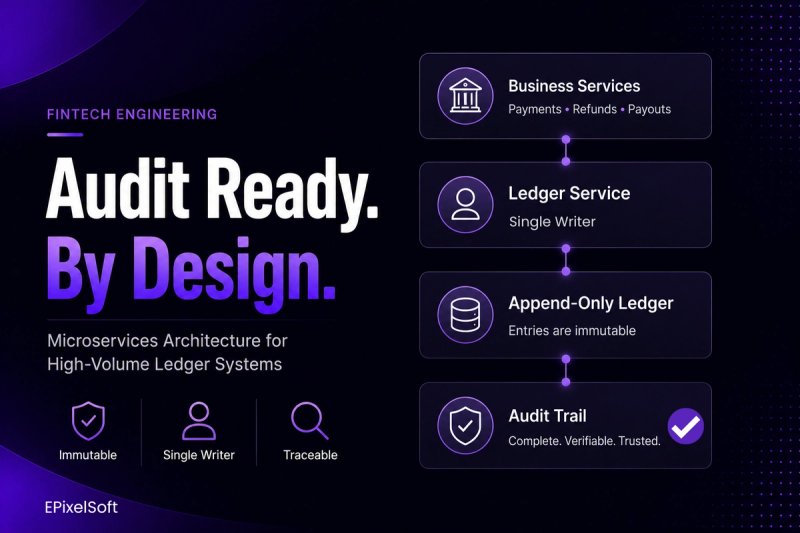
The daily loop is plain. Processor webhooks and bank transaction feeds confirm what settled. A calculation service applies the contract rule and produces a remittance amount or a split percentage. The instruction goes to the processor or the ACH originator. The ledger entry is written in the same transaction, with the inputs, the rule version, and the result stored beside it. Exceptions go to a person: a settlement far below trend, a closed account, a deposit the classifier cannot place.
Stacking needs a more careful reading than most vendors give it. CRS Credit Experts notes that bank statements show what has already cleared, which is the lag where stacking losses live, and recommends bureau and consortium data to close part of that gap. Cobalt Intelligence adds that UCC filings rank by time of filing under Article 9, while bank data still decides repayment capacity. So the agent's role is detection and escalation. A new recurring debit appears, the agent flags it, holds renewal offers, and opens the contractual review. A sweep the contract does not authorize is a new legal problem, and it is the first thing a merchant's lawyer will cite.
What It Actually Takes
The policy layer is the product. Collection ceilings, operating floors, and rail selection live in code outside the model, with every change versioned and approved by a person. Every agent action becomes an immutable event that carries its inputs. A kill switch stops origination for one merchant or for the whole book. Anything that raises a collection amount or touches contract terms waits for human approval.
Compliance rules have moved under this stack. Nacha's fraud monitoring amendments reached all non-consumer ACH originators on June 22, 2026, requiring documented, risk-based processes to detect unauthorized entries and entries authorized under false pretenses. The unauthorized return rate threshold is 0.5%, with administrative returns at 3% and overall returns at 15%, according to Ramp's guide to the rules. A system that raises debit frequency raises that exposure, so return-rate monitoring should be a control the agent cannot override. Disclosure law adds another layer. A 2026 guide from Beancount lists California, New York, Utah, Virginia, Florida, Georgia, Connecticut, Kansas, and Missouri as having commercial financing disclosure rules in effect or imminent. The estimated payments in an offer should match what the system later does.
In underwriting automation we built for a US commercial lending company, the design that held up gave models the reading and explaining, and gave deterministic rules the deciding. Analysts got four times the time back. Payment agents follow the same pattern with higher stakes, because a wrong decision here moves money.
Build the Reconciliation Engine First
Start with one funder, one collection path, and reconciliation. Replay ninety days of historical deposits through the calculation service and compare its output with what the funder actually collected and adjusted. The gaps show where the contract, the data, and the operations team disagree. Add stacking detection after that, then dynamic splits, then instant disbursement.
The funders who win with this will be the ones who can show a court, a bank, and a merchant exactly what the system did on any given day, and why.
Talk to EPixelSoft's engineering team about a scoped architecture review of your collection and reconciliation stack at epixelsoft.com.
EPixelSoft is an AI-native software engineering company based in Noida, India. Since 2014, we have shipped 700+ production systems across FinTech, HealthTech, NGO operations, and SaaS.