Building Software for Field Teams in Emerging Markets: Why Offline-First Is Non-Negotiable


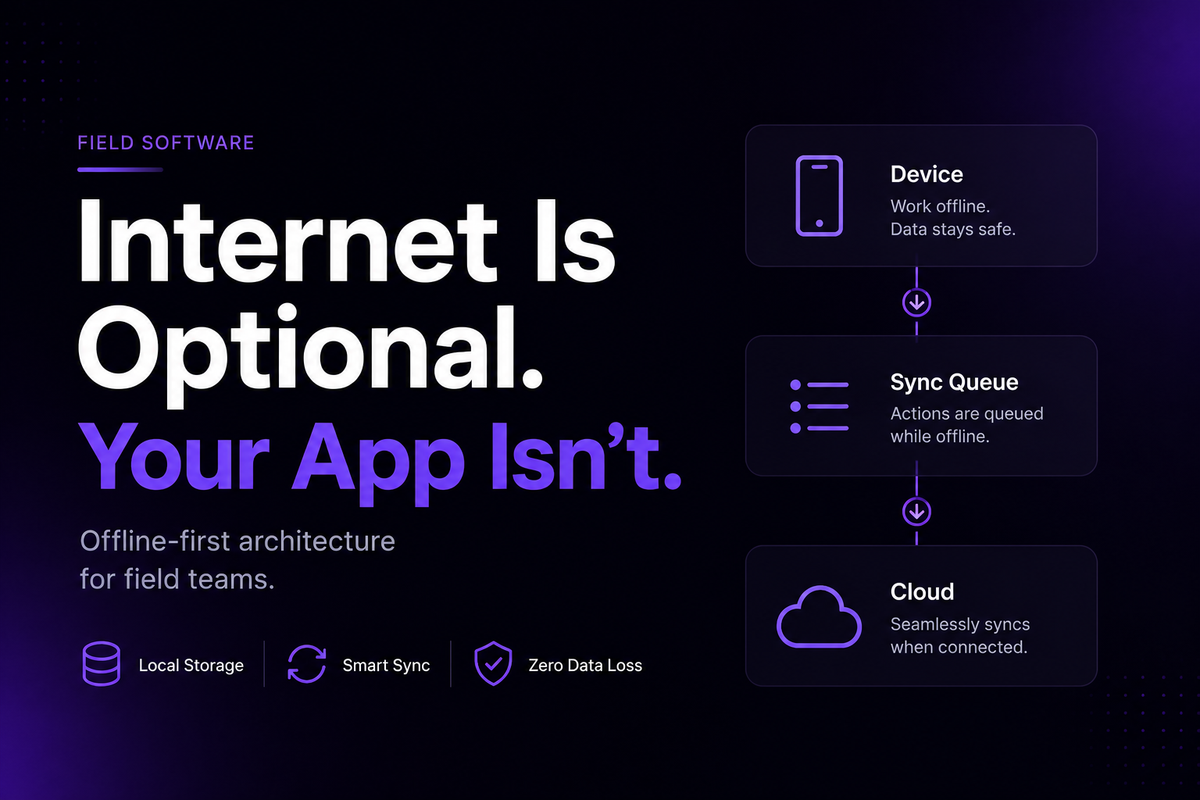
For teams shipping mobile products to field workers across Africa, South Asia, and Latin America, offline-first architecture is the difference between a working system and abandoned software. Storing data locally on the device and syncing when a connection returns keeps enumerators, inspectors, and health workers productive inside dead zones. An NGO in East Africa using this approach cut donor reporting from weeks to minutes. Connectivity in the field is a variable, so the software cannot assume it exists.
Most software that fails in the field does not fail because the code is wrong. It fails because someone assumed the network would be there.
Picture a field officer in rural Tanzania. She opens a survey app, fills in forty answers over twenty minutes, taps submit, and the signal has already dropped. The spinner turns. The data is gone. Multiply that across a hundred enumerators and a three-month programme and you no longer have a data problem. You have a trust problem. The team stops using the tool and quietly goes back to paper.
This is the everyday reality of building for emerging markets, and the numbers behind it are larger than most product teams assume. According to the GSMA Mobile Economy Africa 2026 report, almost one billion people in Africa still do not use mobile internet, roughly 63% of the population. The barrier is rarely a total absence of coverage. It is intermittent, slow, and costly connectivity, which is a harder engineering problem than no connectivity at all.
Why "add offline support later" is the plan that breaks
The common approach is to build the app as if it lives permanently online, then bolt on caching near the end when someone in testing notices the network keeps dropping. This produces a specific class of bug that is painful to fix and easy to ship.
A cached app can show yesterday's screen when the signal fails. It usually breaks the moment the user tries to change something. The form saves halfway. A retry creates a duplicate record. A status update syncs silently in the wrong order and a manager acts on stale information. In the field, these are not edge cases. They are every single day.
The deeper issue is architectural. Treating the network as the single source of truth means every action the user takes becomes a request that can fail. In a stable office, that failure rate is low enough to ignore. Across Sub-Saharan Africa, where the GSMA reports the usage gap is the widest in the world and nearly two-thirds of mobile subscribers still use 3G handsets or feature phones, that failure rate stops being an exception. It becomes the product.
About The Author

Anil Kothiyal
LinkedInAnil Kothiyal is the Founder and CEO of EPixelSoft, an AI-native software engineering firm with 12 years and 700+ products shipped across FinTech, HealthTech, NGO operations, and SaaS. He has led engineering engagements for clients across the US, UK, Africa, and Asia — including platforms that compressed underwriting cycles from days to hours and field reporting systems deployed in East Africa. Anil writes about AI in production, high-stakes software delivery, and what it actually takes to build systems that hold up at scale.